PRINT A WORKSHEET
Area models 4 questions · US Letter · one page per download
Opening the requested worksheet edition… The original sets are available below.
These are the original area-model pages. A4 · student sheet / worked key . All seven original sets are available below.
CHECK THE SAME PROBLEMS
2/3 × 3/4 Question 1 of 4
Unmarked grid on a unit square of 3 rows and 4 columns
Show on the unit squareMy marks Unmarked grid First fraction · rows Second fraction · columns Overlap both fractions Rows I marked Columns I marked
Check my model
Try the partial products Multiply each row part by each column part. Enter the value in their cell.
Previous Next question
SEVEN STARTING POINTS
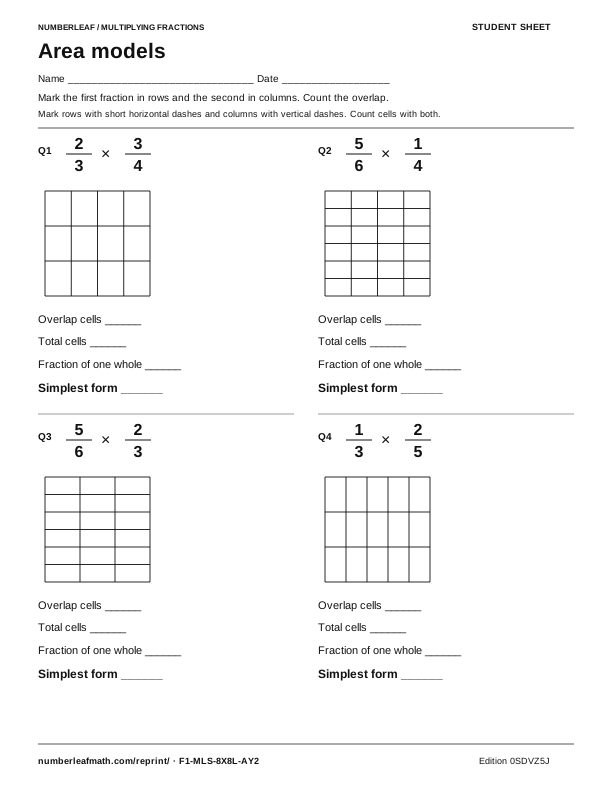
Choose what to practise Area models Shade rows and columns of a unit square. Count the overlap and simplify.
Use this set → Look inside this original setStudent sheet and worked key Choose a page Area models · US Letter · Edition 0SDVZ5J. First problem: 2/3 × 3/4.
Student sheet Worked key Enlarge to print size Scroll inside the enlarged page to read the full line. Image unavailable. Read the text or download this page below.
Download this student sheet (PDF) ↓ Read questions as text Shade rows and columns of a unit square. Count the overlap and simplify.
2/3 × 3/4 5/6 × 1/4 5/6 × 2/3 1/3 × 2/5 Image unavailable. Read the text or download this page below.
Download this worked key (PDF) ↓ Read worked answers as text Shade rows and columns of a unit square. Count the overlap and simplify.
2/3 × 3/4 — 6 of 12 equal cells overlap. Raw product 6/12. Divide both by 6 to get 1/2. 5/6 × 1/4 — 5 of 24 equal cells overlap. Raw product 5/24. This is already in simplest form. 5/6 × 2/3 — 10 of 18 equal cells overlap. Raw product 10/18. Divide both by 2 to get 5/9. 1/3 × 2/5 — 2 of 15 equal cells overlap. Raw product 2/15. This is already in simplest form. Original PDFs · Letter and A4 US Letter · Student / Key / Both
A4 · Student / Key / Both
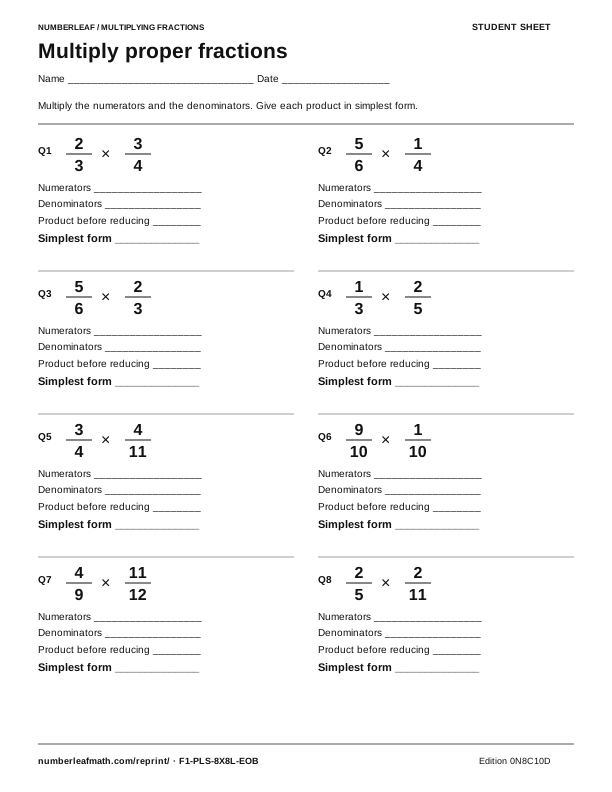
Multiply proper fractions Start with the four model problems, then work with denominators up to 12.
Use this set → Look inside this original setStudent sheet and worked key Choose a page Multiply proper fractions · US Letter · Edition 0N8C10D. First problem: 2/3 × 3/4.
Student sheet Worked key Enlarge to print size Scroll inside the enlarged page to read the full line. Image unavailable. Read the text or download this page below.
Download this student sheet (PDF) ↓ Read questions as text Start with the four model problems, then work with denominators up to 12.
2/3 × 3/4 5/6 × 1/4 5/6 × 2/3 1/3 × 2/5 3/4 × 4/11 9/10 × 1/10 4/9 × 11/12 2/5 × 2/11 Image unavailable. Read the text or download this page below.
Download this worked key (PDF) ↓ Read worked answers as text Start with the four model problems, then work with denominators up to 12.
2/3 × 3/4 — Raw product 6/12. Divide both by 6 to get 1/2. 5/6 × 1/4 — Raw product 5/24. This is already in simplest form. 5/6 × 2/3 — Raw product 10/18. Divide both by 2 to get 5/9. 1/3 × 2/5 — Raw product 2/15. This is already in simplest form. 3/4 × 4/11 — Raw product 12/44. Divide both by 4 to get 3/11. 9/10 × 1/10 — Raw product 9/100. This is already in simplest form. 4/9 × 11/12 — Raw product 44/108. Divide both by 4 to get 11/27. 2/5 × 2/11 — Raw product 4/55. This is already in simplest form. Original PDFs · Letter and A4 US Letter · Student / Key / Both
A4 · Student / Key / Both
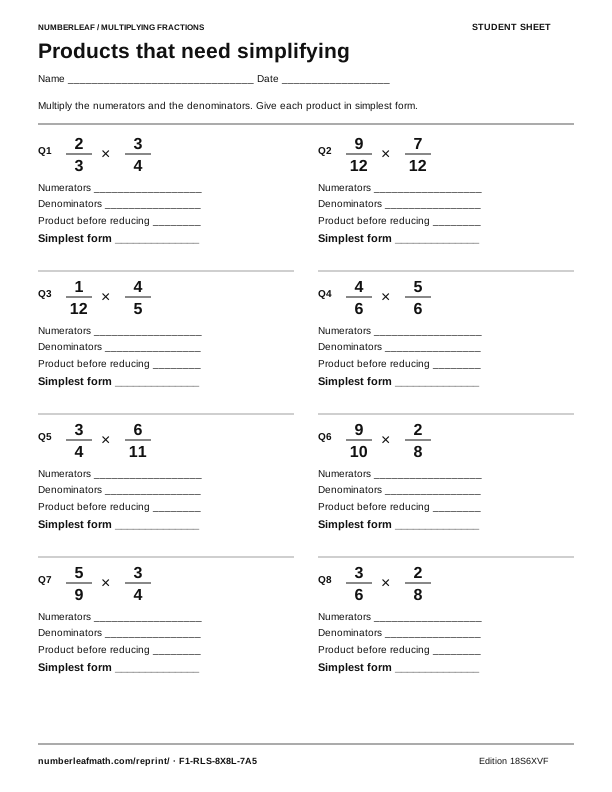
Products that need simplifying Every product can be reduced. Half the problems also let you simplify a factor first.
Use this set → Look inside this original setStudent sheet and worked key Choose a page Products that need simplifying · US Letter · Edition 18S6XVF. First problem: 2/3 × 3/4.
Student sheet Worked key Enlarge to print size Scroll inside the enlarged page to read the full line. Image unavailable. Read the text or download this page below.
Download this student sheet (PDF) ↓ Read questions as text Every product can be reduced. Half the problems also let you simplify a factor first.
2/3 × 3/4 9/12 × 7/12 1/12 × 4/5 4/6 × 5/6 3/4 × 6/11 9/10 × 2/8 5/9 × 3/4 3/6 × 2/8 Image unavailable. Read the text or download this page below.
Download this worked key (PDF) ↓ Read worked answers as text Every product can be reduced. Half the problems also let you simplify a factor first.
2/3 × 3/4 — Raw product 6/12. Divide both by 6 to get 1/2. 9/12 × 7/12 — Raw product 63/144. Divide both by 9 to get 7/16. 1/12 × 4/5 — Raw product 4/60. Divide both by 4 to get 1/15. 4/6 × 5/6 — Raw product 20/36. Divide both by 4 to get 5/9. 3/4 × 6/11 — Raw product 18/44. Divide both by 2 to get 9/22. 9/10 × 2/8 — Raw product 18/80. Divide both by 2 to get 9/40. 5/9 × 3/4 — Raw product 15/36. Divide both by 3 to get 5/12. 3/6 × 2/8 — Raw product 6/48. Divide both by 6 to get 1/8. Original PDFs · Letter and A4 US Letter · Student / Key / Both
A4 · Student / Key / Both
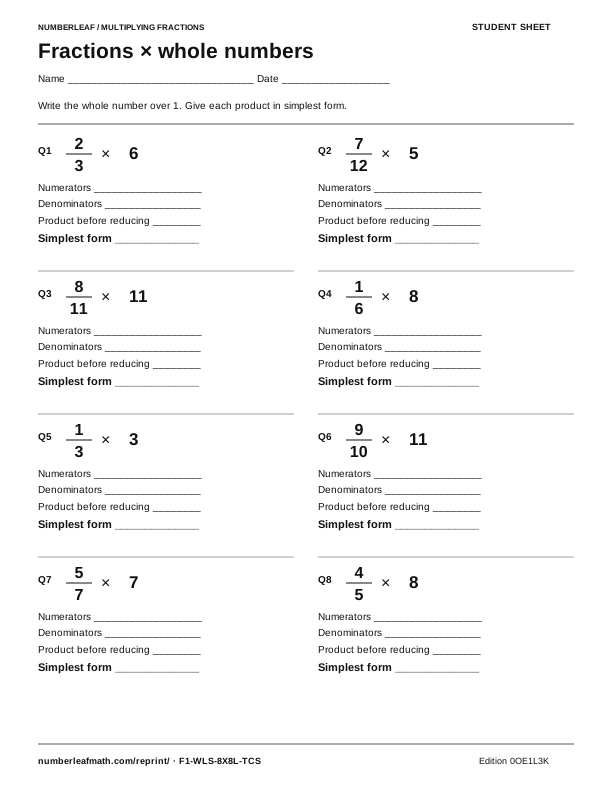
Fractions × whole numbers Find a fraction of a whole number. Practise both integer and fractional answers.
Use this set → Look inside this original setStudent sheet and worked key Choose a page Fractions × whole numbers · US Letter · Edition 0OE1L3K. First problem: 2/3 × 6.
Student sheet Worked key Enlarge to print size Scroll inside the enlarged page to read the full line. Image unavailable. Read the text or download this page below.
Download this student sheet (PDF) ↓ Read questions as text Find a fraction of a whole number. Practise both integer and fractional answers.
2/3 × 6 7/12 × 5 8/11 × 11 1/6 × 8 1/3 × 3 9/10 × 11 5/7 × 7 4/5 × 8 Image unavailable. Read the text or download this page below.
Download this worked key (PDF) ↓ Read worked answers as text Find a fraction of a whole number. Practise both integer and fractional answers.
2/3 × 6 — Raw product 12/3. Divide both by 3 to get 4. 7/12 × 5 — Raw product 35/12. This is already in simplest form. 8/11 × 11 — Raw product 88/11. Divide both by 11 to get 8. 1/6 × 8 — Raw product 8/6. Divide both by 2 to get 4/3. 1/3 × 3 — Raw product 3/3. Divide both by 3 to get 1. 9/10 × 11 — Raw product 99/10. This is already in simplest form. 5/7 × 7 — Raw product 35/7. Divide both by 7 to get 5. 4/5 × 8 — Raw product 32/5. This is already in simplest form. Original PDFs · Letter and A4 US Letter · Student / Key / Both
A4 · Student / Key / Both
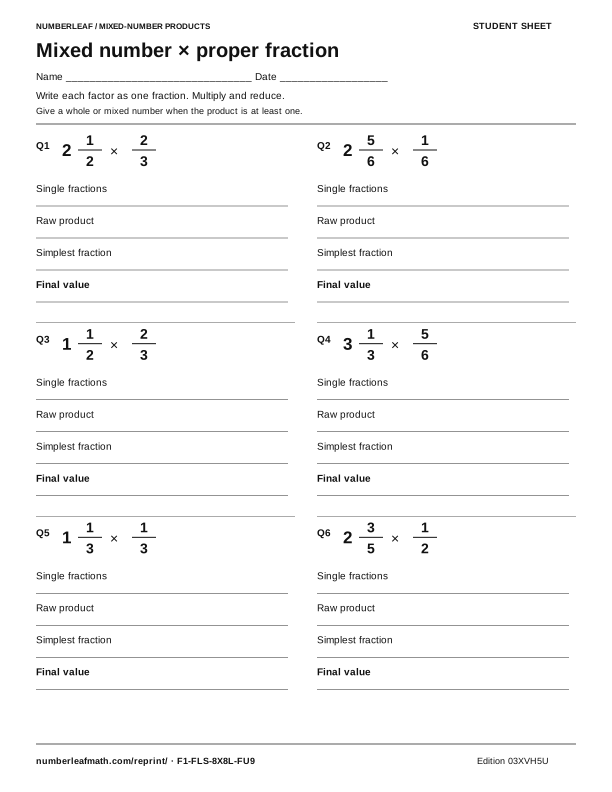
Mixed number × proper fraction Rewrite one mixed factor, multiply and simplify. Check whether a fraction of the starting amount makes sense.
Use this set → Look inside this original setStudent sheet and worked key Choose a page Mixed number × proper fraction · US Letter · Edition 03XVH5U. First problem: 2 1/2 × 2/3.
Student sheet Worked key Enlarge to print size Scroll inside the enlarged page to read the full line. Image unavailable. Read the text or download this page below.
Download this student sheet (PDF) ↓ Read questions as text Rewrite one mixed factor, multiply and simplify. Check whether a fraction of the starting amount makes sense.
2 1/2 × 2/3 2 5/6 × 1/6 1 1/2 × 2/3 3 1/3 × 5/6 1 1/3 × 1/3 2 3/5 × 1/2 Image unavailable. Read the text or download this page below.
Download this worked key (PDF) ↓ Read worked answers as text Rewrite one mixed factor, multiply and simplify. Check whether a fraction of the starting amount makes sense.
2 1/2 × 2/3 — Rewrite as 5/2 × 2/3. Raw product 10/6. Simplest form 5/3. Mixed form 1 2/3. 2 5/6 × 1/6 — Rewrite as 17/6 × 1/6. Raw product 17/36. Simplest form 17/36. 1 1/2 × 2/3 — Rewrite as 3/2 × 2/3. Raw product 6/6. Simplest form 1. 3 1/3 × 5/6 — Rewrite as 10/3 × 5/6. Raw product 50/18. Simplest form 25/9. Mixed form 2 7/9. 1 1/3 × 1/3 — Rewrite as 4/3 × 1/3. Raw product 4/9. Simplest form 4/9. 2 3/5 × 1/2 — Rewrite as 13/5 × 1/2. Raw product 13/10. Simplest form 13/10. Mixed form 1 3/10. Original PDFs · Letter and A4 US Letter · Student / Key / Both
A4 · Student / Key / Both
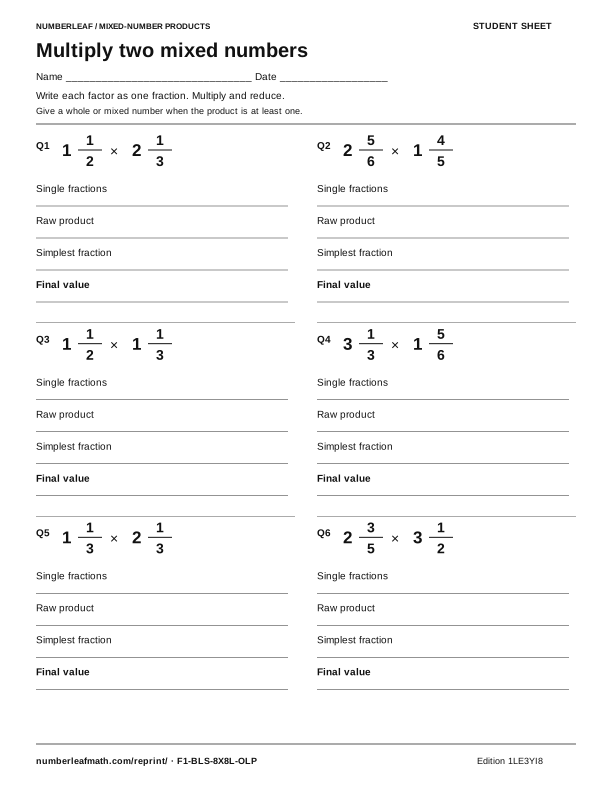
Multiply two mixed numbers Rewrite both factors as improper fractions. Record the raw product, then give its simplest whole or mixed value.
Use this set → Look inside this original setStudent sheet and worked key Choose a page Multiply two mixed numbers · US Letter · Edition 1LE3YI8. First problem: 1 1/2 × 2 1/3.
Student sheet Worked key Enlarge to print size Scroll inside the enlarged page to read the full line. Image unavailable. Read the text or download this page below.
Download this student sheet (PDF) ↓ Read questions as text Rewrite both factors as improper fractions. Record the raw product, then give its simplest whole or mixed value.
1 1/2 × 2 1/3 2 5/6 × 1 4/5 1 1/2 × 1 1/3 3 1/3 × 1 5/6 1 1/3 × 2 1/3 2 3/5 × 3 1/2 Image unavailable. Read the text or download this page below.
Download this worked key (PDF) ↓ Read worked answers as text Rewrite both factors as improper fractions. Record the raw product, then give its simplest whole or mixed value.
1 1/2 × 2 1/3 — Rewrite as 3/2 × 7/3. Raw product 21/6. Simplest form 7/2. Mixed form 3 1/2. 2 5/6 × 1 4/5 — Rewrite as 17/6 × 9/5. Raw product 153/30. Simplest form 51/10. Mixed form 5 1/10. 1 1/2 × 1 1/3 — Rewrite as 3/2 × 4/3. Raw product 12/6. Simplest form 2. 3 1/3 × 1 5/6 — Rewrite as 10/3 × 11/6. Raw product 110/18. Simplest form 55/9. Mixed form 6 1/9. 1 1/3 × 2 1/3 — Rewrite as 4/3 × 7/3. Raw product 28/9. Simplest form 28/9. Mixed form 3 1/9. 2 3/5 × 3 1/2 — Rewrite as 13/5 × 7/2. Raw product 91/10. Simplest form 91/10. Mixed form 9 1/10. Original PDFs · Letter and A4 US Letter · Student / Key / Both
A4 · Student / Key / Both
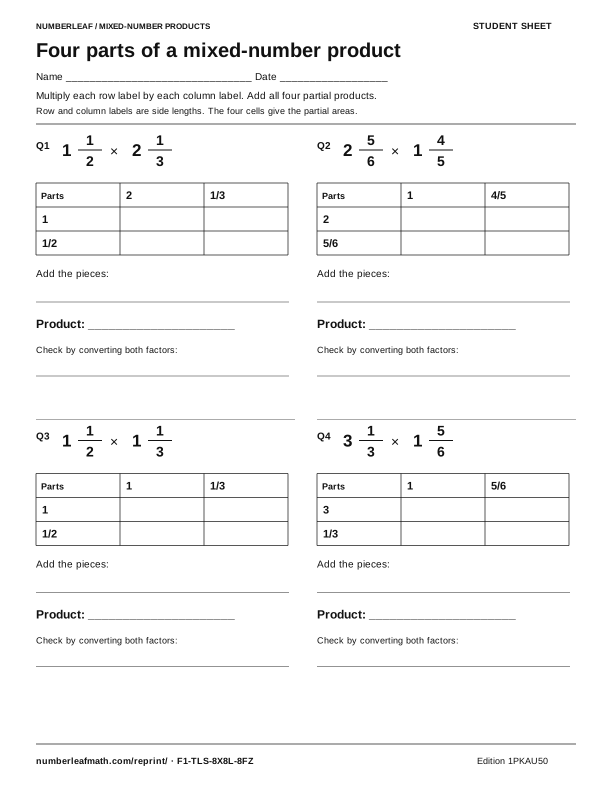
Four parts of a mixed-number product Split both mixed factors into whole and fractional parts. Fill four partial products, then add. Uses the first four questions from the two-mixed-number set.
Use this set → Look inside this original setStudent sheet and worked key Choose a page Four parts of a mixed-number product · US Letter · Edition 1PKAU50. First problem: 1 1/2 × 2 1/3.
Student sheet Worked key Enlarge to print size Scroll inside the enlarged page to read the full line. Image unavailable. Read the text or download this page below.
Download this student sheet (PDF) ↓ Read questions as text Split both mixed factors into whole and fractional parts. Fill four partial products, then add. Uses the first four questions from the two-mixed-number set.
1 1/2 × 2 1/3 2 5/6 × 1 4/5 1 1/2 × 1 1/3 3 1/3 × 1 5/6 Image unavailable. Read the text or download this page below.
Download this worked key (PDF) ↓ Read worked answers as text Split both mixed factors into whole and fractional parts. Fill four partial products, then add. Uses the first four questions from the two-mixed-number set.
1 1/2 × 2 1/3 — 1 × 2 = 2. 1 × 1/3 = 1/3. 1/2 × 2 = 1. 1/2 × 1/3 = 1/6. Sum: 2 + 1/3 + 1 + 1/6 = 3 1/2. 2 5/6 × 1 4/5 — 2 × 1 = 2. 2 × 4/5 = 8/5. 5/6 × 1 = 5/6. 5/6 × 4/5 = 2/3. Sum: 2 + 8/5 + 5/6 + 2/3 = 5 1/10. 1 1/2 × 1 1/3 — 1 × 1 = 1. 1 × 1/3 = 1/3. 1/2 × 1 = 1/2. 1/2 × 1/3 = 1/6. Sum: 1 + 1/3 + 1/2 + 1/6 = 2. 3 1/3 × 1 5/6 — 3 × 1 = 3. 3 × 5/6 = 5/2. 1/3 × 1 = 1/3. 1/3 × 5/6 = 5/18. Sum: 3 + 5/2 + 1/3 + 5/18 = 6 1/9. Original PDFs · Letter and A4 US Letter · Student / Key / Both
A4 · Student / Key / Both
MIXED NUMBERS
Which pieces belong in a mixed-number product? For 2 1/2 × 2/3, write 2 1/2 as 5/2. Multiply by 2/3 to get 10/6, or 1 2/3. The result is less than 2 1/2 because the multiplier is less than one. Try a mixed number times a proper fraction →
For 1 1/2 × 2 1/3, the single fractions are 3/2 and 7/3. Their product is 21/6 = 7/2 = 3 1/2. Splitting the same sides gives 2 + 1/3 + 1 + 1/6 = 3 1/2. If a paper shows 2 1/6, ask which two areas the learner added. The whole-by-fraction and fraction-by-whole pieces contribute another 1/3 and 1.
Print two mixed factors → · Print the same first four as partial-product boxes →
AT THE MARKING TABLE
Did the product change, or only its name? For 2/3 × 3/4, split one square into 3 equal rows and 4 equal columns. Mark two rows and three columns. A horizontal dash marks a row and a vertical dash marks a column. Cells with both marks form the overlap, 6 of the 12 equal cells. Six cells have both marks and six do not, so the overlap covers exactly 1/2 of the square.
In the simplifying set, half the problems have a factor that can be reduced before multiplying. For example, 6/8 × 3/12 becomes 3/4 × 1/4, giving 3/16.
A child who writes 6/12 has found the right area. Ask for its simplest name. A child who writes 5/7 may have added both numerators and denominators. Ask them to count the overlap before repeating the calculation.
The area and proper-fraction sets share their first four questions when made with the same edition. The whole-number set alternates products that are whole numbers and products that have a fractional part. An improper fraction or a mixed number can describe the same answer.
This lesson practises selected fifth-grade fraction multiplication skills in Common Core 5.NF.B.4 . To connect hundredths to area, use multiplying decimals worksheets . To practise the standard algorithm with whole numbers, use three-digit by two-digit multiplication .
To recover a printed edition, enter its F1 code in Find my worksheet .
Compare the sizes of products or print a mixed review in the fifth grade multiplication guide .
Teacher or tutor feedback
Used these fraction sheets with a learner? Tell us how they worked. Please leave out student names, answers and identifying details.
Email huzifan08@gmail.com with the worksheet title and how many lessons you used it in. Please leave out student information.
Review your email draft Open it in your email app, or copy it into your email service. You decide whether to send it.
 Look inside this original setStudent sheet and worked key
 Look inside this original setStudent sheet and worked key
 Look inside this original setStudent sheet and worked key
 Look inside this original setStudent sheet and worked key
 Look inside this original setStudent sheet and worked key
 Look inside this original setStudent sheet and worked key
 Look inside this original setStudent sheet and worked key