READY TO PRINT
Tenths on a hundred grid 4 questions · US Letter · separate answer key
Opening the requested worksheet edition… The original sets are available below.
Practice setTenths on a hundred grid Decimals × whole numbers Multiply two decimals Decimals × 10, 100 or 1,000 Paper sizeUS Letter A4
New questions Original sheet Copy worksheet link
Add this set to a packet → Preview & print this worksheet
These are the original hundred-grid pages. A4 · Student sheet / Worked key . The original files for all four sets are below.
CHECK THE SAME PROBLEMS
0.6 × 0.4 Question 1 of 4
Unmarked grid on a unit square of 10 rows and 10 columns
Show on the hundred gridBlank whole First factor · rows Second factor · columns Show the overlap
Compare the same digits → Previous Next question
TWO-QUESTION FOLLOW-UP
Same digits, different value
Practice slip PDF ↓ Slip key PDF ↓
FOUR PRACTICE SETS
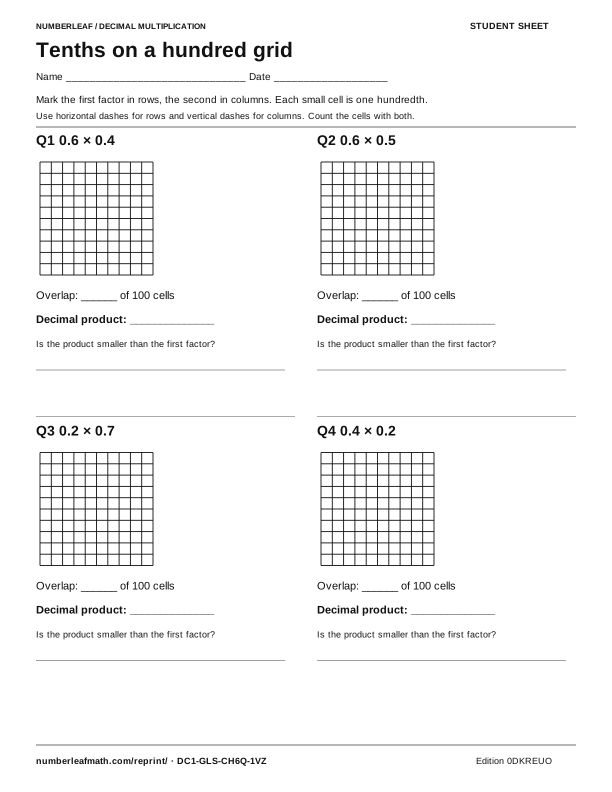
Choose a starting point Tenths on a hundred grid Mark two tenths factors on a 10-by-10 unit square. Count the overlap in hundredths.
Use this set → Look inside this original setStudent sheet and worked key Choose a page Tenths on a hundred grid · US Letter · Edition 0DKREUO. First problem: 0.6 × 0.4.
Student sheet Worked key Enlarge to print size Scroll inside the enlarged page to read the full line. Image unavailable. Read the text or download this page below.
Download this student sheet (PDF) ↓ Read questions as text Mark two tenths factors on a 10-by-10 unit square. Count the overlap in hundredths.
0.6 × 0.4 0.6 × 0.5 0.2 × 0.7 0.4 × 0.2 Image unavailable. Read the text or download this page below.
Download this worked key (PDF) ↓ Read worked answers as text Mark two tenths factors on a 10-by-10 unit square. Count the overlap in hundredths.
0.6 × 0.4 — 24 of 100 cells overlap. 6 × 4 = 24. Decimal places: 1 + 1 = 2. Product 0.24. 0.4 < 1, so the product is less than 0.6. 0.6 × 0.5 — 30 of 100 cells overlap. 6 × 5 = 30. Decimal places: 1 + 1 = 2. Product 0.30 = 0.3. 0.5 < 1, so the product is less than 0.6. 0.2 × 0.7 — 14 of 100 cells overlap. 2 × 7 = 14. Decimal places: 1 + 1 = 2. Product 0.14. 0.7 < 1, so the product is less than 0.2. 0.4 × 0.2 — 8 of 100 cells overlap. 4 × 2 = 8. Decimal places: 1 + 1 = 2. Product 0.08. 0.2 < 1, so the product is less than 0.4. Original PDFs · Letter and A4 US Letter · Student / Key / Both
A4 · Student / Key / Both
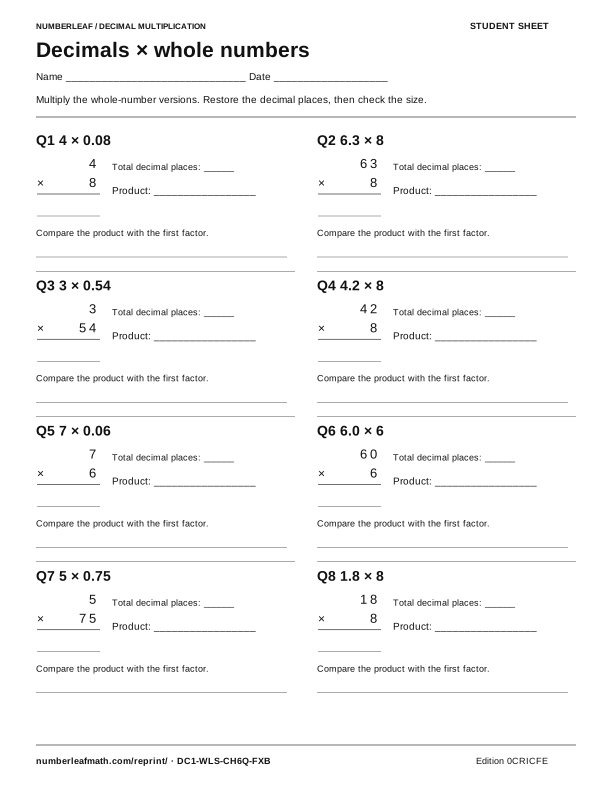
Decimals × whole numbers Multiply a decimal by a whole number and locate the product using place value.
Use this set → Look inside this original setStudent sheet and worked key Choose a page Decimals × whole numbers · US Letter · Edition 0CRICFE. First problem: 4 × 0.08.
Student sheet Worked key Enlarge to print size Scroll inside the enlarged page to read the full line. Image unavailable. Read the text or download this page below.
Download this student sheet (PDF) ↓ Read questions as text Multiply a decimal by a whole number and locate the product using place value.
4 × 0.08 6.3 × 8 3 × 0.54 4.2 × 8 7 × 0.06 6.0 × 6 5 × 0.75 1.8 × 8 Image unavailable. Read the text or download this page below.
Download this worked key (PDF) ↓ Read worked answers as text Multiply a decimal by a whole number and locate the product using place value.
4 × 0.08 — 4 × 8 = 32. Decimal places: 0 + 2 = 2. Product 0.32. 0.08 < 1, so the product is less than 4. 6.3 × 8 — 63 × 8 = 504. Decimal places: 1 + 0 = 1. Product 50.4. 8 > 1, so the product is greater than 6.3. 3 × 0.54 — 3 × 54 = 162. Decimal places: 0 + 2 = 2. Product 1.62. 0.54 < 1, so the product is less than 3. 4.2 × 8 — 42 × 8 = 336. Decimal places: 1 + 0 = 1. Product 33.6. 8 > 1, so the product is greater than 4.2. 7 × 0.06 — 7 × 6 = 42. Decimal places: 0 + 2 = 2. Product 0.42. 0.06 < 1, so the product is less than 7. 6.0 × 6 — 60 × 6 = 360. Decimal places: 1 + 0 = 1. Product 36.0 = 36. 6 > 1, so the product is greater than 6.0. 5 × 0.75 — 5 × 75 = 375. Decimal places: 0 + 2 = 2. Product 3.75. 0.75 < 1, so the product is less than 5. 1.8 × 8 — 18 × 8 = 144. Decimal places: 1 + 0 = 1. Product 14.4. 8 > 1, so the product is greater than 1.8. Original PDFs · Letter and A4 US Letter · Student / Key / Both
A4 · Student / Key / Both
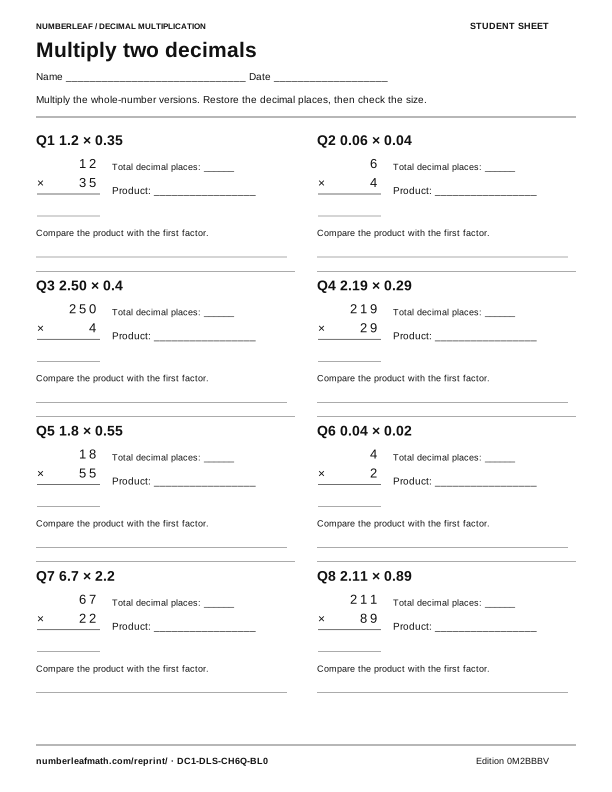
Multiply two decimals Use the whole-number calculation and then place the point. Includes tenths and hundredths in both factors.
Use this set → Look inside this original setStudent sheet and worked key Choose a page Multiply two decimals · US Letter · Edition 0M2BBBV. First problem: 1.2 × 0.35.
Student sheet Worked key Enlarge to print size Scroll inside the enlarged page to read the full line. Image unavailable. Read the text or download this page below.
Download this student sheet (PDF) ↓ Read questions as text Use the whole-number calculation and then place the point. Includes tenths and hundredths in both factors.
1.2 × 0.35 0.06 × 0.04 2.50 × 0.4 2.19 × 0.29 1.8 × 0.55 0.04 × 0.02 6.7 × 2.2 2.11 × 0.89 Image unavailable. Read the text or download this page below.
Download this worked key (PDF) ↓ Read worked answers as text Use the whole-number calculation and then place the point. Includes tenths and hundredths in both factors.
1.2 × 0.35 — 12 × 35 = 420. Decimal places: 1 + 2 = 3. Product 0.420 = 0.42. 0.35 < 1, so the product is less than 1.2. 0.06 × 0.04 — 6 × 4 = 24. Decimal places: 2 + 2 = 4. Product 0.0024. 0.04 < 1, so the product is less than 0.06. 2.50 × 0.4 — 250 × 4 = 1000. Decimal places: 2 + 1 = 3. Product 1.000 = 1. 0.4 < 1, so the product is less than 2.50. 2.19 × 0.29 — 219 × 29 = 6351. Decimal places: 2 + 2 = 4. Product 0.6351. 0.29 < 1, so the product is less than 2.19. 1.8 × 0.55 — 18 × 55 = 990. Decimal places: 1 + 2 = 3. Product 0.990 = 0.99. 0.55 < 1, so the product is less than 1.8. 0.04 × 0.02 — 4 × 2 = 8. Decimal places: 2 + 2 = 4. Product 0.0008. 0.02 < 1, so the product is less than 0.04. 6.7 × 2.2 — 67 × 22 = 1474. Decimal places: 1 + 1 = 2. Product 14.74. 2.2 > 1, so the product is greater than 6.7. 2.11 × 0.89 — 211 × 89 = 18779. Decimal places: 2 + 2 = 4. Product 1.8779. 0.89 < 1, so the product is less than 2.11. Original PDFs · Letter and A4 US Letter · Student / Key / Both
A4 · Student / Key / Both
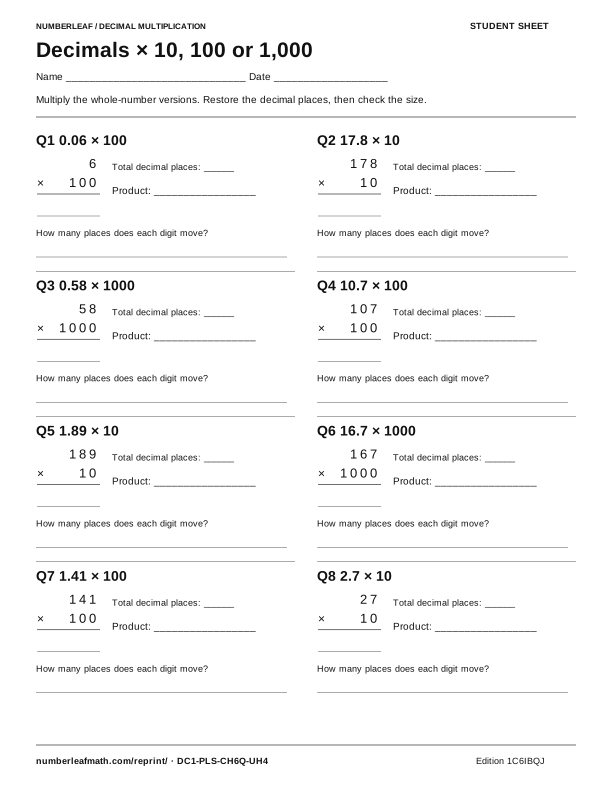
Decimals × 10, 100 or 1,000 Follow the value of each digit when multiplying by a power of ten.
Use this set → Look inside this original setStudent sheet and worked key Choose a page Decimals × 10, 100 or 1,000 · US Letter · Edition 1C6IBQJ. First problem: 0.06 × 100.
Student sheet Worked key Enlarge to print size Scroll inside the enlarged page to read the full line. Image unavailable. Read the text or download this page below.
Download this student sheet (PDF) ↓ Read questions as text Follow the value of each digit when multiplying by a power of ten.
0.06 × 100 17.8 × 10 0.58 × 1000 10.7 × 100 1.89 × 10 16.7 × 1000 1.41 × 100 2.7 × 10 Image unavailable. Read the text or download this page below.
Download this worked key (PDF) ↓ Read worked answers as text Follow the value of each digit when multiplying by a power of ten.
0.06 × 100 — 6 × 100 = 600. Decimal places: 2 + 0 = 2. Product 6.00 = 6. Each digit moves 2 places left. 17.8 × 10 — 178 × 10 = 1780. Decimal places: 1 + 0 = 1. Product 178.0 = 178. Each digit moves 1 place left. 0.58 × 1000 — 58 × 1000 = 58000. Decimal places: 2 + 0 = 2. Product 580.00 = 580. Each digit moves 3 places left. 10.7 × 100 — 107 × 100 = 10700. Decimal places: 1 + 0 = 1. Product 1070.0 = 1070. Each digit moves 2 places left. 1.89 × 10 — 189 × 10 = 1890. Decimal places: 2 + 0 = 2. Product 18.90 = 18.9. Each digit moves 1 place left. 16.7 × 1000 — 167 × 1000 = 167000. Decimal places: 1 + 0 = 1. Product 16700.0 = 16700. Each digit moves 3 places left. 1.41 × 100 — 141 × 100 = 14100. Decimal places: 2 + 0 = 2. Product 141.00 = 141. Each digit moves 2 places left. 2.7 × 10 — 27 × 10 = 270. Decimal places: 1 + 0 = 1. Product 27.0 = 27. Each digit moves 1 place left. Original PDFs · Letter and A4 US Letter · Student / Key / Both
A4 · Student / Key / Both
AT THE MARKING TABLE
Are the digits wrong, or is the value wrong? For 0.6 × 0.4, mark six rows and four columns of a hundred grid. The overlap covers 24 cells, each worth 0.01. It represents 0.24 of the whole. Since 0.4 is less than one, the product must be smaller than 0.6.
For 1.2 × 0.35, the whole-number calculation is 12 × 35 = 420. One decimal place plus two gives three places before trimming. Write 0.420. The shorter form 0.42 has the same value. If a learner writes 4.2, inspect the whole-number step before deciding what to reteach.
Multiplying 0.06 by 100 makes each digit worth one hundred times as much. Six hundredths become six ones. Compare that with 0.06 × 0.04, where four decimal places are needed to write 0.0024.
The tenths models and whole-number sets practise selected place-value work in Common Core 5.NBT.B.7 . The two-decimal set extends to products in thousandths and ten-thousandths. For another view of the same area, try multiplying fractions . For larger whole numbers, use three-digit multiplication .
Use the DC1 code on a printed sheet in Find my worksheet . For a mixed check, open the fifth grade multiplication guide . Original decimal sets can also be combined in a worksheet packet .
Teacher or tutor feedback
Used these decimal worksheets with a learner? Tell us how they worked. Please leave out student names, answers and identifying details.
Email huzifan08@gmail.com with the worksheet title and how many lessons you used it in. Please leave out student information.
Review your email draft Open it in your email app, or copy it into your email service. You decide whether to send it.
 Look inside this original setStudent sheet and worked key
 Look inside this original setStudent sheet and worked key
 Look inside this original setStudent sheet and worked key
 Look inside this original setStudent sheet and worked key