Long multiplication in columns
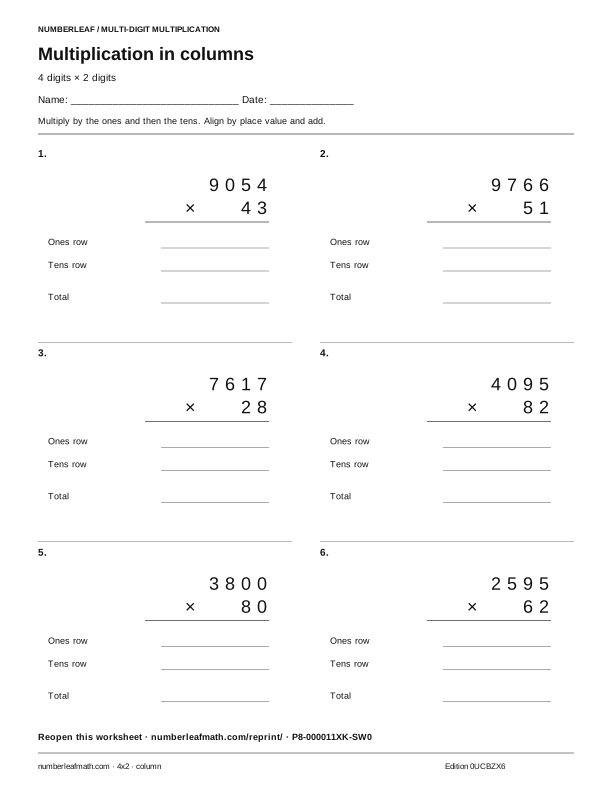
Write the ones row and the shifted tens row, then add. The first problem has a zero in the hundreds place.
 numberleaf.A little less prep.
WRITTEN MULTIPLICATION / FOUR DIGITS BY TWO
Start with six guided problems in columns or as matching area models. For independent practice, print sixteen problems on one page. Both formats have worked answer keys.
PRINT FOR YOUR LESSON
Write the ones row and the shifted tens row, then add. The first problem has a zero in the hundreds place.
Use the same six problems as the columns sheet. Split the four-digit factor by place, keeping any zero column.
Practise two nonzero partial rows. Neither multiplying nor adding the rows needs a carry.
Every problem requires a carry while multiplying or adding the partial products.
REPEATED PRACTICE
Choose a track for the week or give different sets to the same class. Each sheet has six problems. Set 1 matches the single sheet in that track above. Products never repeat within a track.
Download one set at a time or print all five. The complete pack places the five student pages first, followed by the five numbered keys. To reprint a set, enter the set and pack label at the top of the page.
Both partial products are nonzero. No carrying is needed when multiplying or adding. Five of the six first factors on each sheet contain a zero.
Every problem needs a carry. On each sheet, four problems need carrying in both multiplication rows, four need carrying in the final addition, and one multiplier ends in zero.
INDEPENDENT PRACTICE
Use one sheet of sixteen vertical problems when students can set up both partial rows independently. Each worked key shows the ones row, shifted tens row and total in the same position as the student problem.
Choose one set, or take all five for 80 different products in one track. Each complete pack contains the five student pages followed by their five keys. For more writing space, use the six-problem sheets.
Set 1 · With regrouping
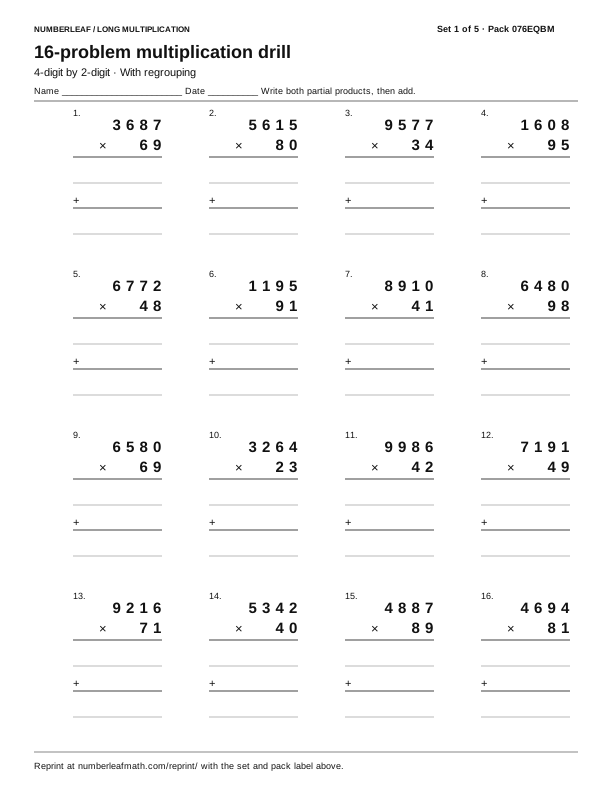
Both partial products are nonzero. There are no carries in multiplication or in the final addition.
Each problem involves a carry. Two of the sixteen multipliers on every sheet end in zero.
QUESTION 1 ON BOTH MIXED SHEETS
Rounding to 9,000 × 40 gives 360,000. Use that estimate to check the size of the final answer.
Enter your own multiplication and see every partial row →
If a learner writes 36,216 for the tens row, they have multiplied by 4. Ask where the product of 40 × 9,054 belongs. If the zero in 9,054 disappears, use the area model to keep the empty hundreds column visible.
In question 5, the multiplier is 80. The ones partial product is zero. The tens row carries the full value of 80 × 3,800.
This topic appears in England’s Year 5 mathematics programme. For a smaller number first, try 3-digit by 2-digit multiplication. For a third partial row, try 3-digit by 3-digit multiplication.
Report an issue with question 1 →
Used the four-digit by two-digit sheets with a learner? Tell us how they worked. Please leave out student names, answers and identifying details.
Open it in your email app, or copy it into your email service. You decide whether to send it.